Black Cab Drivers Vs Uber
How the digital economy has changed the role of a taxi driver, and future implications
Uber’s rapid global expansion has been a product of their deliberate strategy of being a market disruptive innovator, where their use of technology and the sharing economy has enabled them to outperform regulators and competitors (Dudley, Banister, & Schwanen, 2017). The rise of this platform-based ride-hailing app has resulted in implications for not only the traditional role of taxi drivers, but it has also changed business models, and employment patterns globally (Dudley, Banister, & Schwanen, 2017).

The traditional Black Cab drivers’ business model has come under threat since the launch of ride sharing services, such as Uber, who have capitalised from their investments in both the digital and gig economy (Cramer & Krueger, 2016). The emergence of digital technologies has given rise to an economic revolution, in which workers have been able to transform themselves into micro-entrepreneurs (Tucker, 2019). Uber’s innovation of internet-based ride sharing services has taken advantage of this fact and treats their drivers as self-employed micro-entrepreneurs, providing unprecedented competition for not only Black Cab drivers, but the taxi industry as a whole (Cramer & Krueger, 2016; Tucker, 2019). Consequently, the current job role held by highly knowledgeable Black Cab drivers and their present business model is at risk of becoming obsolete in the not so distant future.
Part of Uber’s success is their use of digital technology where the initial bookings, the route, the calculation of fares, and payments are all made through their mobile app, providing consumers with a streamlined, hassle-free service (Dudley, Banister, & Schwanen, 2017). Their use of self-employed drivers means that supply can more accurately match demand, resulting in a more efficient, cost effective business model (Dudley, Banister, & Schwanen, 2017). Thus, allowing Uber to undercut fares charged by the likes of the Black Cabs, resulting in multiple protests from Black Cab drivers. Although Uber has been successful in London, they have suffered from adverse media reports and investigations from TFL. These events, combined with the development of a Black Cab’s app in response to Uber’s entry into the London market has left Uber struggling to compete (Dudley, Banister, & Schwanen, 2017).
Although Uber has now lost their license in London due to problems with insurance and safety (Topham, 2019), Uber still represents a significant threat to traditional taxi firms, and similar competitors have now flooded the market such as Ola and Lyft. This begs the questions of how will Uber and other operators respond to increased competition in the taxi industry? And, how could digital innovations be expanded further?
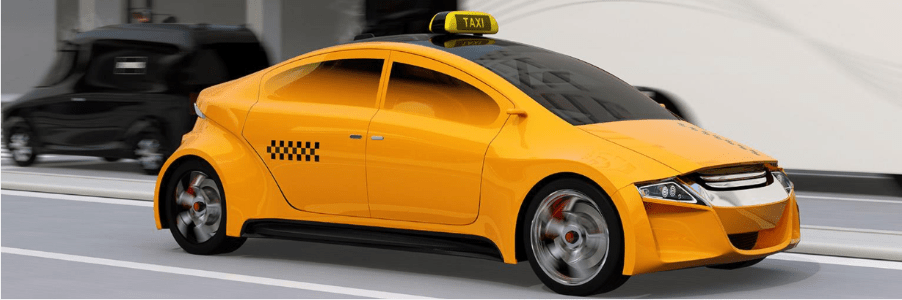
So, what could the future of the taxi industry look like? The past few years have seen the likes of Google and Uber investing significantly in the race to introduce self-driving cars to our roads (Tussyadiah, Zach, & Wang, 2017). Advances in artificial technology combined with robotic technology have allowed for the development of autonomous vehicles, representing another major disruptive technological change for the taxi industry (Pettigrew, Fritschi, & Norman, 2018). This combination of technology allows the vehicle to process information to avoid delays from traffic or road accidents without requiring human aid (Tussyadiah, Zach, & Wang, 2017). Therefore, autonomous vehicles will be able to provide an efficient and safe service to consumers.
This Mckinsey report provides a reputable overview of the future of mobility, highlighting the projected impacts of autonomous vehicles. Not only does the introduction of the autonomous vehicle represents a large technological disruption for the taxi industry, but it also signals a diminishing demand for professional drivers globally (Pettigre, Fritschi, & Norman, 2018; Tussyadiah, Zach, & Wang, 2017). Therefore, many would consider this movement towards autonomous vehicles to be dehumanising. However, speculation over just how safe these self-driving cars can be arose in 2018 after a fatal incident involving an Uber self-driving car (Lee, 2019). Therefore, there may be no imminent threat to traditional taxi drivers’ jobs as public confidence in autonomous vehicles may be slow to build.
Not only will self-driving vehicles cause wide spread job loss, but they will disrupt our future mobility behaviour, and mark the end of mass private-car ownership in many towns across the world (Heineke, Kampshoff, Kellner, & Kloss, 2019). Other potential disadvantages of self-driving vehicles includes increased traffic due to an increase in overall travel as costs decline, as well as concerns over privacy and security (Pettigrew, Fritschi, & Norman, 2018).
Regardless of the downsides to autonomous vehicles, the taxi industry is inevitably moving towards adopting this technology. Black Cab drivers may have to further innovate their business models to take advantage of digital technologies in order to remain competitive as autonomous vehicles slowly enter the taxi market. Although the uptake of self-driving taxis may be slow, unless a balance can be struck between these vehicles and traditional taxi drivers, severe widespread job loss appears to be inevitable as drivers’ knowledge will eventually become redundant.
REFERENCE LIST
Cramer, J., & Krueger, A. (2016). Disruptive Chnage in the Taxi Business: The Case of Uber. National Bureau of Economic Research.
Dudley, G., Banister, D., & Schwanen, T. (2017). The rise of Uber and regulating the disruptive innovator. The political quarterly, 88(3), 492-499.
Flickr. (n.d.). Flickr. Retrieved February 2020, from Flickr.com: https://www.flickr.com/photos/altugkarakoc/48851184996/in/photolist-2hqP6mh-dYVCue-81Aeiw-2h72N1J-QMcDub-2hHMEFw-9cXN1S-9jfiGf-3pBUf6-2hXQ1jc-SWR2B7-zido4-3cvf7C-Lk4Jyf-23k4Nwx-A8zxAA-2gsDvHW-4Sg58V-3R8z6-jF6Dq-ddM4Tq-qco7Q5-nqi6xT-zYB9x4-esjTQq-TZAvEU-dz
Heineke, K., Kampshoff, P., Kellner, M., & Kloss, B. (2019, June). Change vehicles: How robo-taxis and shuttles will reinvent mobility. Retrieved February 2020, from McKinsey: https://www.mckinsey.com/industries/automotive-and-assembly/our-insights/change-vehicles-how-robo-taxis-and-shuttles-will-reinvent-mobility
Lee, D. (2019, November 20). Uber self-driving crash ‘mostly caused by human error’. Retrieved February 2020, from BBC News: https://www.bbc.co.uk/news/technology-50484172
McKinsey & Company. (n.d.). Autonomous Driving. Retrieved February 2020, from McKinsey & Company: https://www.mckinsey.com/features/mckinsey-center-for-future-mobility/overview/autonomous-driving
Pettigrew, S., Fritschi, L., & Norman, R. (2018). The Potential Implications of Autonomous Vehicles in and around the Workplace. International journal of environmental research and public health, 15(9), 1876.
Topham, G. (2019, Novemeber 25). Uber loses London licence after TfL finds drivers faked identity. Retrieved January 2020, from The Guardian: https://www.theguardian.com/technology/2019/nov/25/uber-loses-licence-london-tfl
Tucker, E. (2019). Uber and the unmaking and remaking of taxi capitalisms: technology, law and resistance in historical perspective. SSRN Electronic Journal, 357-383.
Tussyadiah, I., Zach, F., & Wang, J. (2017). Attitudes toward autonomous on demand mobility system: The case of the self-driving taxi. Information and communication technologies in tourism, 755-766.
 Kirstyn's Blog
Hi Kirstyn,
I’m very appreciate your topic. I think everyone must took the traditional taxi and uber even though the latter one has not been commonly accepted worldwide. Nonetheless, it is no doubt that Uber keep survive by utilizing the technology. The high efficiency and cost effective made competitive advantage compared to black cab.
I took once Uber in Hong Kong although it’s illegal there. It risks the traditional taxi and afterwards every taxi own one smartphone at least for receiving the orders. The most interesting fact I’ve seen is 7 phones in front of the driving wheel!
Uber makes people travel more comfort, but have we consider the way of traditional is out of creative? For instant, they can only take the order in particular place. If you ask me, the black cab should boost their performance by introducing technology rather than resist Uber.
LikeLike
Hi, Kristyn
Indeed, with the help of technology, Uber’s efficiency and convenience have attracted a large number of customers. At the same time, it also brought a shock to the traditional Taxi industry. There is no doubt that many drivers who do not have a taxi license have been offered a living but have also had a huge impact on the income of taxi drivers.
You mentioned that even if there are many areas for improvement, the taxi industry will develop in the direction of self-driving in the future. I agree with you, it could be very from countries to countries. For example, developed countries such as the United States and the United Kingdom have a greater possibility that all taxis will be self-driving in the near future. Because these countries have rich capital and industry giants such as Uber. But in some developing countries, it may take longer to achieve the same thing. Personally, I still have concerns about the safety of self-driving but I still look forward to such a day, after all, it is too convenient.
LikeLike
Hi Kirstyn!
Great post here, I found this to be an extremely interesting and unbiased post which discussed all aspects (positive and negative) of how the digital economy has impacted on an industry and job role. When discussing the effect of disruptive innovators such as Uber it is easy to fall into the trap of side taking, especially considering that the Black Cab driver is a staple of one of our wonderful cities.
It surprises me that to become a Black Cab driver one must still pass the Knowledge of London test which takes 3-4 years to complete and is used to prove that an individual holds an encyclopedic knowledge of London streets and tourist attractions. This is particularly astounding considering that Google Maps launched 14 years ago removing the need to memorise routes and with websites such as TripAdvisor tourists can find any information they need regarding attractions online or through an app.
Not only does it seem like the industry is facing an uphill battle against competitors such as Uber but also with the decreasing value of this knowledge and the high barrier to entry it is easy to imagine a time where the official title of London Black Cab driver becomes extinct. This may account for the -0.6% decrease of Total Licensed Vehicles in London in 2019, compared with the 18.4% increase in 2015.
I’m intrigued to know what capabilities you think taxi firms would have to develop to compete in this hyper competitive environment and if you think it is possible for them to adapt enough to develop a sustained competitive advantage?
Transport for London. (2020). Learn the Knowledge of London. Retrieved February 18, 2020 from https://tfl.gov.uk/info-for/taxis-and-private-hire/licensing/learn-the-knowledge-of-london
Department of Transport. (2015). Taxi and Private Hire Vehicle
Statistics: England 2015. Retrieved from https://assets.publishing.service.gov.uk/government/uploads/system/uploads/attachment_data/file/456733/taxi-private-hire-vehicles-statistics-2015.pdf
Department of Transport. (2019). Taxi and Private Hire Vehicle
Statistics, England 2019. Retrieved from https://assets.publishing.service.gov.uk/government/uploads/system/uploads/attachment_data/file/833569/taxi-and-phv-england-2019.pdf
LikeLike
Hi Kirstyn,
A very interesting read! There is no doubt that the “classic” taxi industry is slowly dying whilst Uber is taking over. After all, it was only a matter of time until someone came up with something better. Just like so many other people in London, I use Uber all the time and I can’t remember the last time I even got a black cab, so the recent protests from black cab drivers are not surprising. They realise the threat and don’t want to lose their jobs. I personally witnessed a big clash between an Uber driver and a taxi driver at the Nice airport which resulted in Uber drivers being banned from picking customers up from the airport. Either way, I think competition is good for everyone and will be interesting to see what happens in the future.
You mentioned autonomous vehicles and major disruptive technological changes they represent for the taxi industry. I think driverless vehicles are definitely a great way of cutting the costs and there is no doubt that Uber and other apps will try and capitalise on that. However, the question is, how safe are the automated taxis? I think that the human factor is important when it comes to driving and solely relying on self-driving technology in the future can be dangerous. Therefore, I think that ‘self-driving’ cars will need people who can monitor them to make driving safe.
LikeLike