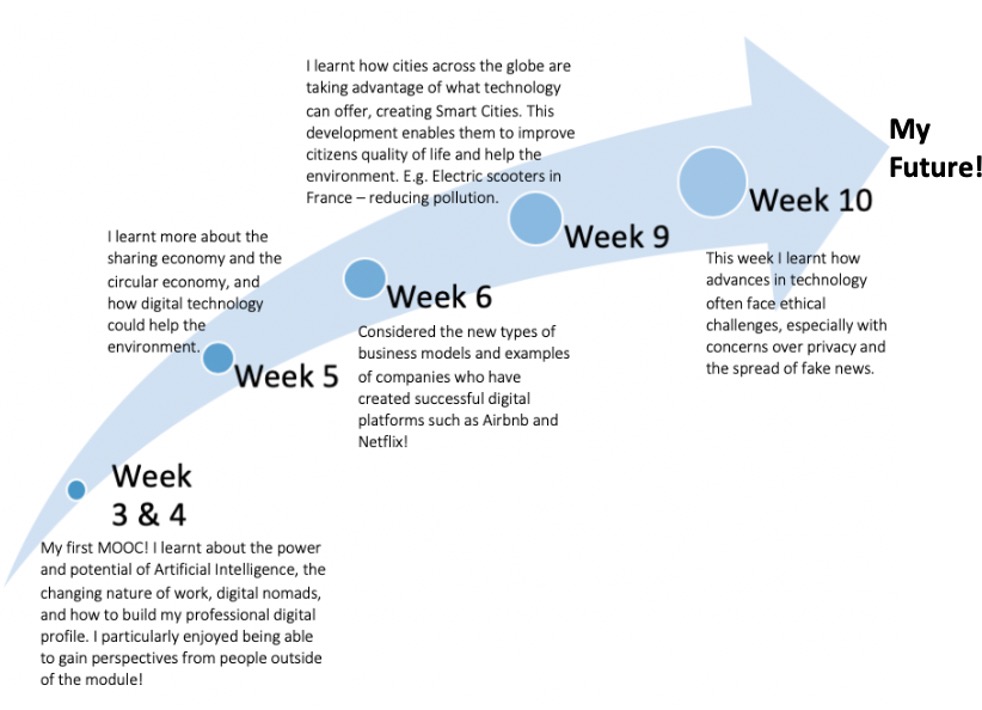
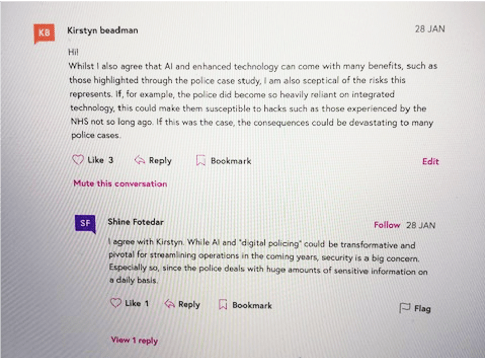
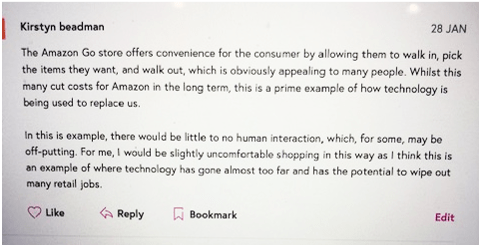
BEMM129 Digital Business Models has opened my eyes to the benefits and downsides of the digital world, and I am excited to see how this world develops. As I fall under the ‘early majority’ category for adopting new technologies, I think it is important to welcome and embrace changes in technology (Rogers, 1962). A highlight for me was discovering digital business models from different countries and how they have been successful, such as Lime, from Daniel’s blog, who have successfully capitalised from the sharing economy. Other highlights are shown below.
Figure 1: Highlights of the term.
How the Digital World is Changing the Nature of Work
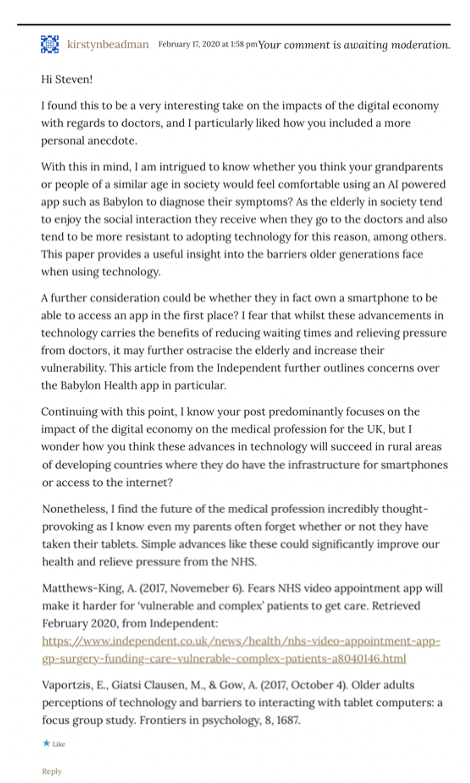
This was the topic of our first blogpost, how job roles are being changed by advances in digital technology. I found this topic to be the most thought-provoking as I found it the most applicable to my future career choice. From Steven’s blog I learnt how healthcare is becoming increasingly powered by AI and apps such as Babylon Health. Therefore, making seeing a doctor more accessible, but presenting challenges for those who do not possess a smartphone. Despite the fact that I am eager to embrace changes in technology, the MOOC caused me to reflect on both the benefits and the drawbacks of technology. For example, the case of the Amazon Go store enhances convenience for the consumer, however, if this format became common place, many retail jobs could be lost. Previously, I assumed AI would bring copious benefits and make jobs easier, such as with the case of the iPolice. Yet, these cases have made me realise the ethical implications of technology, such as privacy concerns, and that jobs could be impacted due to these advances. This prompted my first blogpost about Black Cab drivers and Uber, who have exploited the sharing and gig economies (Cramer & Krueger, 2016).
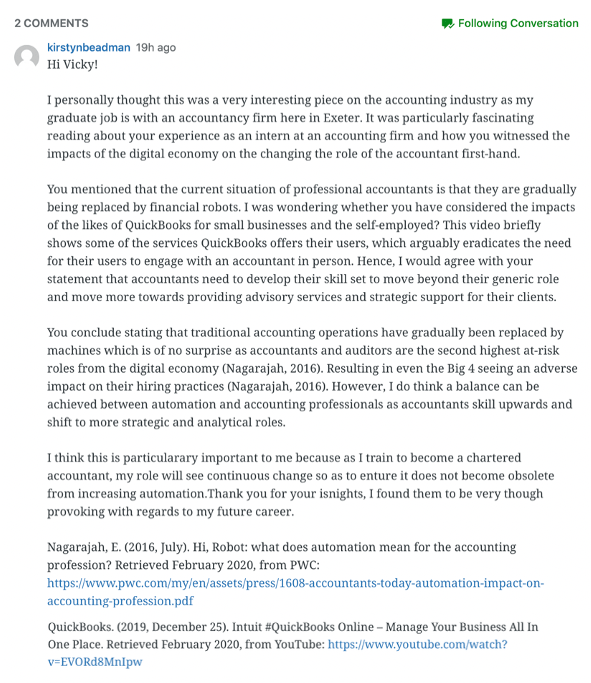
The most informative blog, for me, was Vicky’s as I learnt about impact of technology on the Accounting profession, which is my future career. This opened my eyes to how the role is changing to a more advisory function due to the fact that accountants are the second highest at-risk role from advances in technology (Nagarajah, 2016). Consequently, this enabled me to reflect on how my role as an accountant may be different to how we traditionally view accountants, and what I can do to prepare for this change.
What Will I Take Forward?
BEMM129 has allowed me to experience learning in a different format, preparing me for the future way of working. It has also made me realise the importance of using blogs and LinkedIn to enhance my knowledge and express my interests, whilst expanding my network.
Airbnb: The Digital Evolution of the Hotel Industry
How Airbnb’s digital business model has contributed to their success
The new age of Hotels
After years of very little change, the hotel industry has experienced the emergence of digital platforms such as Airbnb who operate with no fixed assets. Airbnb is an accommodation rental platform that launched in 2007 when Brian Chesky and Joe Gebbia started an Airbed & Breakfast on their living room floor in San Francisco (Statista, 2018). Airbnb’s rapid growth has come from their ability to differentiate themselves from traditional hotel chains by fundamentally changing society’s approach to accommodation and leveraging the power of technology to create vast networks. Consequently, Airbnb is now considered one of the largest hotel firms as 2 million people stay in Airbnb’s every night, across 100,000 cities worldwide (Airbnb, 2020). But what is it about Airbnb’s digital business model that has made them so successful?
The following YouTube video provides a comprehensive overview of Airbnb and how the concept developed to what we know today.
The true success of Airbnb’s concept was seen in 2013 as sales started to threaten those of longstanding hotel chains such as Marriott, proving that Airbnb had successfully flipped the traditional hotel business model on its head. Since then, Airbnb’s sales have grown exponentially, as shown in figure 1 (Hancock, 2019a). Today, Airbnb has 6 million listings, spanning across 191 countries, meaning that they have more listings than the top 5 hotel brands combined (BMI, 2020; Airbnb, 2020). However, much of the effort of traditional hotels to combat Airbnb’s online competition has focused on simply improving loyalty schemes (Hancock, 2019a). In fact, it wasn’t until April 2019 that Airbnb saw any significant retaliation from traditional hotel groups as Marriott launched its own home rental service and Accor acquired Onefinestay (Hancock, 2019b). Consequently, both stepped into Airbnb’s market.
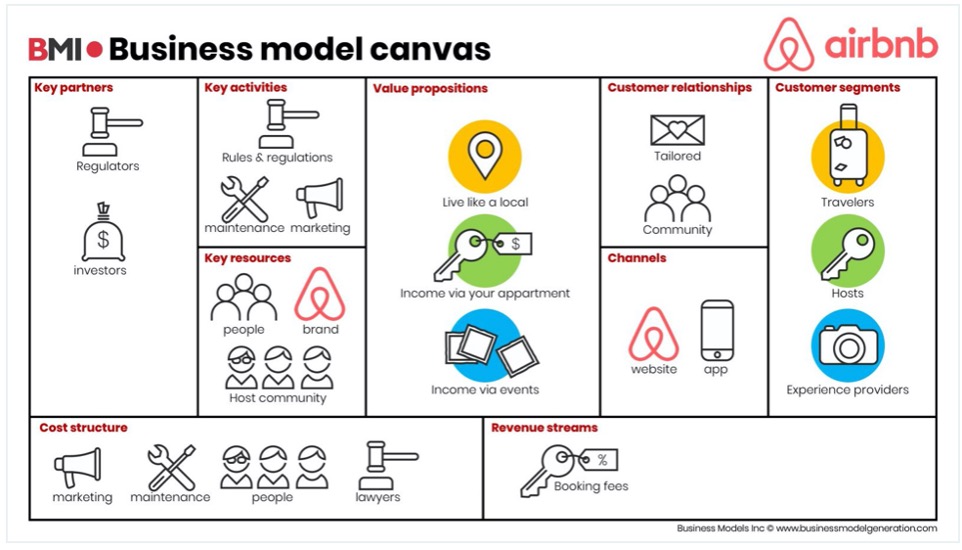
Airbnb’s business model of a peer-to-peer two-sided marketplace on a digital platform connects travellers with hosts and experience providers (BMI, 2020). This business model has caused significant shifts in the hospitality market by enabling Airbnb to scale hospitality through connecting mass markets in a unique way that considerably outcompetes that of traditional hotels (BMI, 2020). This digital business model has also led to Airbnb’s considerable success through the fact that they do not own any fixed assets (Figure 2), allowing them to operate with significantly lower costs and higher profit margins than normal hotel chains. Figure 2 illustrates Airbnb’s business model canvas and highlights how they add value for consumers to outcompete their market.
Part of Airbnb’s success can be attributed to their use of ‘Social, Mobile, Analytics and Cloud’ (SMAC). Whereby they have interconnected social media accounts such as Facebook to track and store cookies from users’ browser history, allowing for a more personalised service. In addition to this, Airbnb has successfully developed an app for smartphones to increase the number of people able to access their platform as the number of smartphone users today stands at roughly 3.5 billion and counting (Statista, 2019). By capitalising on this increased use of mobile technology and engaging effectively in social media, Airbnb is able to tap into new ways of engaging with their consumers as well as acquiring them, which has helped put them ahead of traditional hotel groups. Beyond this, Airbnb also allows users to share stays and experiences via a plethora of social media platforms, which allows content to be shared in a single touch whilst aiding their success (Olenski, 2016).
The Sharing Economy
A significant factor in Airbnb’s success has been their ability to tap into the sharing economy. For those who are unfamiliar with the sharing economy, the video below shows an overview of this concept and also draws upon many organisations who have successfully capitalised from its mounting importance.
Whilst the sharing economy is not a new concept, Airbnb’s digital business model, which matches consumers to hosts with surplus rooms or entire houses, has made this transaction possible at an extraordinary scale. Hosts who own assets benefit from being able to fill their spare capacity, whilst guests have somewhere more interesting to stay and experience a place as a local would, and in return, Airbnb charges a fee to both parties (Moore, 2020). By modelling their business around the sharing economy, Airbnb has also benefited from the rising concerns for sustainability over the past decade as consumers see this as a more sustainable alternative to hotels (Heinrichs, 2013).
Part of the success Airbnb has experienced from this aspect of their business model is also due to their peer-to-peer reviews, in which both hosts and guests can review one another to ultimately build trust among the community of users. Not only this, but Airbnb also carries out comprehensive background checks for both hosts and guests among other safety precautions (Airbnb, 2020).
Airbnb has truly embraced the digital era and taken the hotel industry in a unique direction. But will they remain successful as competitors start to innovate and encroach on their market?
Heinrichs, H. (2013, December 17). Sharing economy: a potential new pathway to sustainability. GAIA-Ecological Perspectives for Science and Society, 22(4), 228-231.
How the digital economy has changed the role of a taxi driver, and future implications
Uber’s rapid global expansion has been a product of their deliberate strategy of being a market disruptive innovator, where their use of technology and the sharing economy has enabled them to outperform regulators and competitors (Dudley, Banister, & Schwanen, 2017). The rise of this platform-based ride-hailing app has resulted in implications for not only the traditional role of taxi drivers, but it has also changed business models, and employment patterns globally (Dudley, Banister, & Schwanen, 2017).
Figure 1: Taxi. From Flickr.com.
The traditional Black Cab drivers’ business model has come under threat since the launch of ride sharing services, such as Uber, who have capitalised from their investments in both the digital and gig economy (Cramer & Krueger, 2016). The emergence of digital technologies has given rise to an economic revolution, in which workers have been able to transform themselves into micro-entrepreneurs (Tucker, 2019). Uber’s innovation of internet-based ride sharing services has taken advantage of this fact and treats their drivers as self-employed micro-entrepreneurs, providing unprecedented competition for not only Black Cab drivers, but the taxi industry as a whole (Cramer & Krueger, 2016; Tucker, 2019). Consequently, the current job role held by highly knowledgeable Black Cab drivers and their present business model is at risk of becoming obsolete in the not so distant future.
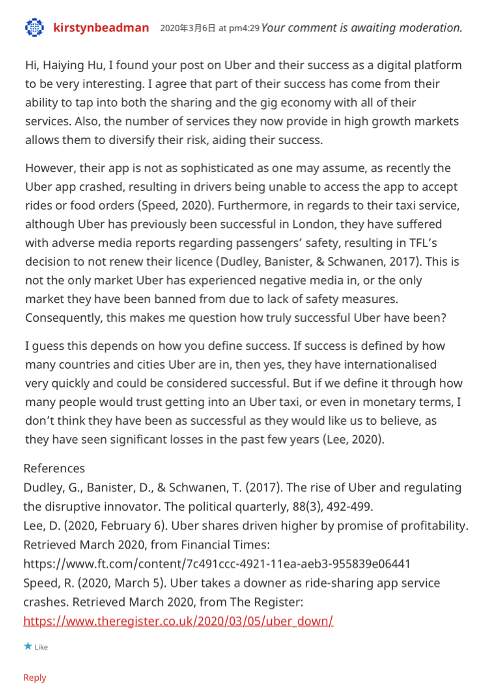
Part of Uber’s success is their use of digital technology where the initial bookings, the route, the calculation of fares, and payments are all made through their mobile app, providing consumers with a streamlined, hassle-free service (Dudley, Banister, & Schwanen, 2017). Their use of self-employed drivers means that supply can more accurately match demand, resulting in a more efficient, cost effective business model (Dudley, Banister, & Schwanen, 2017). Thus, allowing Uber to undercut fares charged by the likes of the Black Cabs, resulting in multiple protests from Black Cab drivers. Although Uber has been successful in London, they have suffered from adverse media reports and investigations from TFL. These events, combined with the development of a Black Cab’s app in response to Uber’s entry into the London market has left Uber struggling to compete (Dudley, Banister, & Schwanen, 2017).
Although Uber has now lost their license in London due to problems with insurance and safety (Topham, 2019), Uber still represents a significant threat to traditional taxi firms, and similar competitors have now flooded the market such as Ola and Lyft. This begs the questions of how will Uber and other operators respond to increased competition in the taxi industry? And, how could digital innovations be expanded further?
So, what could the future of the taxi industry look like? The past few years have seen the likes of Google and Uber investing significantly in the race to introduce self-driving cars to our roads (Tussyadiah, Zach, & Wang, 2017). Advances in artificial technology combined with robotic technology have allowed for the development of autonomous vehicles, representing another major disruptive technological change for the taxi industry (Pettigrew, Fritschi, & Norman, 2018). This combination of technology allows the vehicle to process information to avoid delays from traffic or road accidents without requiring human aid (Tussyadiah, Zach, & Wang, 2017). Therefore, autonomous vehicles will be able to provide an efficient and safe service to consumers.
This Mckinsey report provides a reputable overview of the future of mobility, highlighting the projected impacts of autonomous vehicles. Not only does the introduction of the autonomous vehicle represents a large technological disruption for the taxi industry, but it also signals a diminishing demand for professional drivers globally (Pettigre, Fritschi, & Norman, 2018; Tussyadiah, Zach, & Wang, 2017). Therefore, many would consider this movement towards autonomous vehicles to be dehumanising. However, speculation over just how safe these self-driving cars can be arose in 2018 after a fatal incident involving an Uber self-driving car (Lee, 2019). Therefore, there may be no imminent threat to traditional taxi drivers’ jobs as public confidence in autonomous vehicles may be slow to build.
Not only will self-driving vehicles cause wide spread job loss, but they will disrupt our future mobility behaviour, and mark the end of mass private-car ownership in many towns across the world (Heineke, Kampshoff, Kellner, & Kloss, 2019). Other potential disadvantages of self-driving vehicles includes increased traffic due to an increase in overall travel as costs decline, as well as concerns over privacy and security (Pettigrew, Fritschi, & Norman, 2018).
Regardless of the downsides to autonomous vehicles, the taxi industry is inevitably moving towards adopting this technology. Black Cab drivers may have to further innovate their business models to take advantage of digital technologies in order to remain competitive as autonomous vehicles slowly enter the taxi market. Although the uptake of self-driving taxis may be slow, unless a balance can be struck between these vehicles and traditional taxi drivers, severe widespread job loss appears to be inevitable as drivers’ knowledge will eventually become redundant.
REFERENCE LIST
Cramer, J., & Krueger, A. (2016). Disruptive Chnage in the Taxi Business: The Case of Uber. National Bureau of Economic Research.
Dudley, G., Banister, D., & Schwanen, T. (2017). The rise of Uber and regulating the disruptive innovator. The political quarterly, 88(3), 492-499.
Pettigrew, S., Fritschi, L., & Norman, R. (2018). The Potential Implications of Autonomous Vehicles in and around the Workplace. International journal of environmental research and public health, 15(9), 1876.
Tucker, E. (2019). Uber and the unmaking and remaking of taxi capitalisms: technology, law and resistance in historical perspective. SSRN Electronic Journal, 357-383.
Tussyadiah, I., Zach, F., & Wang, J. (2017). Attitudes toward autonomous on demand mobility system: The case of the self-driving taxi. Information and communication technologies in tourism, 755-766.
Hello, I’m Kirstyn and I am originally from Shropshire, England but I have been studying in Exeter for the past 4 years. I am currently studying MSc International Management. Previous to undertaking my masters, I completed my undergraduate degree in Business and Management, also at the University of Exeter.
My main motivation for choosing the Digital Business Models module was because I haven’t had the opportunity to study a module like this during my time at Exeter. I believe this area could provide me with a good skill set for when I enter the workplace as digital business models is very relevant to the way in which most businesses work today.




 Kirstyn's Blog